The issue of hair and women of color is a hands-off topic if you’re not a woman of color. Which I’m not.
But I’m going to talk about it anyway, even though I’m whiter than white, with stick straight hair that’s a faded blonde color, and I fight with it all the time. Sometimes the hair wins, sometimes I lose. But with women of color, from what I understand, there is the issue of good hair and bad hair, and a continuum between the two.
I’m not sure what the rules are to determine what constitutes good hair or bad hair, but I imagine if anyone (black, white, green, yellow, male, female, transgender, etc.) has hair that is longer than a few inches, then there is a daily battle. Please show me one person who doesn’t fight with their hair. Let me hear one story about someone who says they have perfect, obedient hair and I will call them a lair.
So all of this has to do with the movie Belle, which I just went to see over the weekend. Being a fan of historical films and historical novels, I treated myself to a huge popcorn and coke, and to going alone so I could savor the texture of the past. I awaited with baited breath to see the content and eddies of not just people wearing elegant clothes, but of people dealing with washbasins, and chamber pots, and mud in the streets, and rats in the gutter, and all those items of gritty reality that make historical films and novels come alive for me. More about my disappointment with this later.
But first I want to talk about Dido’s hair in this movie. The year is 1750-something, and Dido, a young mulatto girl, is originally brought by her white father to live with his uncle, Lord Mansfield.
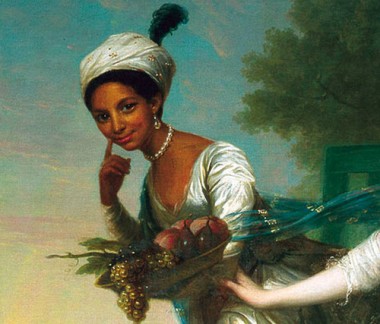
Years pass and Lord Mansfield, Dido’s guardian, becomes the Lord Chief Justice, pretty much the highest position in all of England, second only to the King. He’s powerful enough to flout the social mores of the time and raise a mulatto child right next to his own niece. He’s rich enough to drape both of his charges in silk and enough pearls to choke an elephant. We’re talking rich, rich, rich, and very powerful.
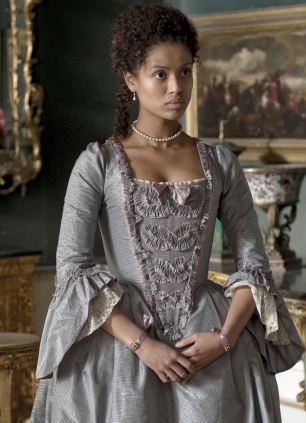
(Enough pearls and silk to choke an elephant)
At one point in the movie, the Mansfield family travels to London so that Elizabeth can have her coming out there. (Dido gets no coming out because she’s a mulatto.)
Pay close attention to this scene: when the Mansfield family arrives in London, each of them are assisted by a servant, who takes off each person’s hat and cloak as if the Mansfield family had no arms, or if they did, no power to move them. Everyone is still draped in silk and pearls. It is obvious that they are typically waited upon hand and foot.
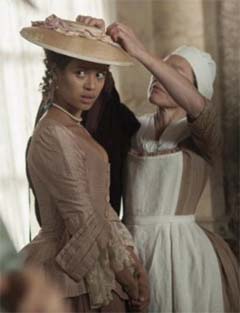
That night, Dido and Elizabeth get ready for bed. Mabel, the black maid with a Scottish accent, brings them their bed socks and observes that Dido is having trouble combing her hair. She then offers to help, and gently points out that it’s easier to comb through hair if you start at the ends first.
Answer me this: if the Mansfield family is rich enough to have servants disrobe them upon entry to their London townhouse, why on earth is Dido combing her own hair?
A second question: if Dido is having trouble combing her own hair, why is she having trouble? Dido is at least sixteen years old if not older. She’s old enough to know, as is anyone with hair longer than two inches, that yes, it’s easier if you start at the ends.
I’m truly not sure which is more important a question to raise, whether Dido is old enough to know about the starting-at-the-ends concept, or whether she’s of a family that’s so rich that she never would even imagine combing her own hair.
Young, blonde Elizabeth is standing by, watching this small drama unfold. Please note that Elizabeth’s hair is coiffed to a fare-thee-well, coiled and curled, and beautifully arranged, and all of this just so she can go to bed. Who did her hair, then? Did she do it herself? Hell no. She’s a high quality lady, and would no more do her own hair than she would clean out her own chamberpot. The same standards apply, or should apply, to Dido. Yet we see Dido struggling to comb her own hair.
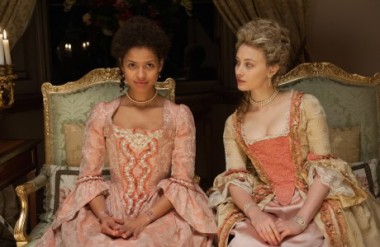
Dido, alongside Elizabeth, has been raised in one of the richest families of the land. Â Her guardian, Lord Mansfield (according to this movie) is able to overturn slavery in England almost singlehandedly. Dido would have had a maid all of her life. She never would have washed her own clothes, or drawn her own water for a bath, or swept the dust bunnies out from beneath her charming twin bed, let alone combed her own hair. Ever. (And if the aforementioned is not true, then, the fact remains that Dido has been dealing with her own hair long enough to know how to handle it.)
So then I ask myself, why is she struggling with her hair? Why did this movie determine that it was appropriate to ignore two fairly obvious basic facts?
I think it’s so that we can witness Mabel, with her delightful Scottish burr, as she comes up and instructs Dido that it’s easier if you start at the ends. It’s a sweet scene, but it seems to a bad job serving a good purpose, that is, placing two characters who have, it seems, some things in common.
You in the large looking glass both the mulatto raised as an heiress and the black maid who is (as Lord Mansfield points out) not a slave and is very well paid. Â We are meant to see them at the same time, and notice the differences. That Dido, for all her wealth and fancy upbringing, is no more able to chart her own course than Mable, who must work for a living.
That’s about all I could glean from this scene, once my irritation had fizzled out over the anachronistic details in the hair combing scene.
Here’s my other points of irritation.
Ms. Mbatha-Raw, who plays Dido, is a very beautiful and talented actress, however, she seemed to have spent most of her time standing around with unshed tears in her eyes. Granted, she was very, very good at this, and the first time it happened, her unshed tears went halfway up her eyeballs. This is a skill on the same level that Mickey Rooney was professed to have: when a director asked Mickey to do a little crying for a particular scene, Mickey was reported to have asked whether the director wanted the tears halfway down his cheeks or three quarters of the way down, and then delivered the required amount of tears on the spot.

(The Adorable Mickey Rooney)
Ms. Mbatha-Raw has this same talent, in the area of unshed tears. I suppose I should blame her director, for not asking more of her; by the end of the movie, where she’s pleading with her guardian to let her marry the nice young man, the unshed tears make their 50th appearance, and I was a little unmoved at this point.
Then I got irritated with the lack of reality. As I mentioned earlier, I love the texture and grittiness of historical films; I want to see the mud, and the rats, and the horrible plumbing, and I want it realistic enough so that I can almost smell the sweat. This movie, for all it looked like it would be realistic, was not. There are few settings: the garden, the bedroom, the dining room, an entry way, and the pavement in front of an old, cream colored building. Each scene seemed to contain a dearth of servants, and this in the age of servants.
And what were they eating at breakfast all those times?
At breakfast, the Mansfield family dines on fresh fruit, and not much else. I guess I was looking for a repeat of the fantastic breakfast scene in the 1995 movie Pride and Prejudice, where the family is eating cold, sliced beef (or was it ham?), sausages, small beer, and hot baked goods and butter. Now that was a realistic breakfast! But no, the Mansfield family dines on fresh fruit and tea….there is no cold meat pie, no pigeon breast, in fact no sign of any protein products at all, which, according to pretty much every description of John Bull that I’ve ever read, flies in the face of British eating habits.
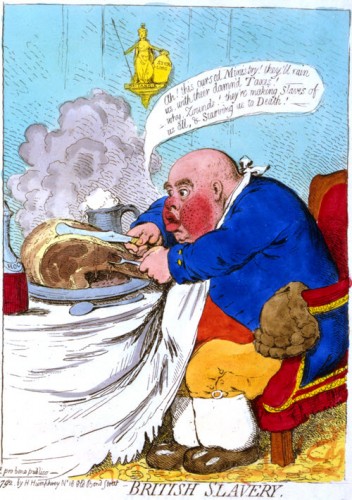
(John Bull – He eats a lot.)
Then there’s bedtime. In addition to the aforementioned hair issue, the two girls sleep in cute, matching twin beds. They are instantly dressed for bed, including Elizabeth’s hair, but we never see them dressing or undressing. There is no washing up at the basin, no handing over of soiled linens to anyone, no brushing teeth with twigs, nothing. And given how straightforward their nighttime rituals are (instant sleep-readiness!), there are a lot of scenes with Elizabeth and Dido whispering in bed together.
In addition to that, the two young ladies stand around in their beautiful gowns. A lot.
Oh sure, once or twice the characters walk the muddy streets along the Thames, but the streets have only a thin slime of mud, and that’s it. Moreover, Dido and her beau traverse along the Thames at the very location where tanners are preparing their hides. But there is no sign of the effluvia, no indication that the whole area reeks of decomposing flesh, let alone the buckets and buckets of dog turds needed to process the hides and make them supple. Nope. Lady and lad walk along as if they were in a field of lavender.
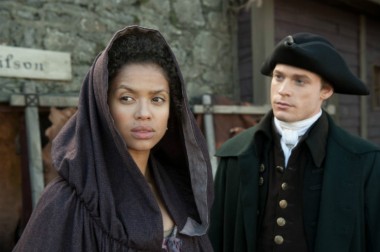
(Dido and her Beau)
In the whole of this movie there were no chamber pots, no washbasins, and no one even writes with a feather pen! I was very disappointed.
One thing I found very interesting, was the way people of color were positioned in paintings when they were in a painting along with a white person. In the beginning, we are shown that the person of color has a position that is low; their eyes gaze upwards, as if transfixed by the person of higher rank.
Here’s an example, of Lady Elizabeth Keppel by Joshua Reynolds.
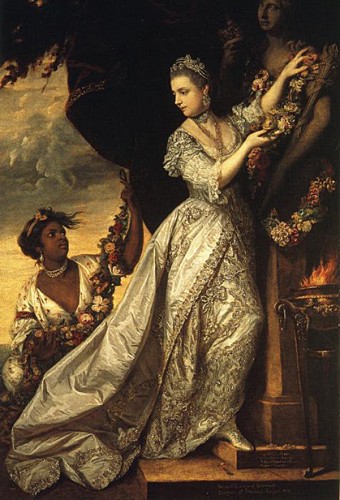
(Lady Elizabeth Keppel by Joshua Reynolds)
When Lord Mansfield orders that a portrait be done of Elizabeth and Dido together, Dido fears, as might be expected, that the same will be done with her. And who can blame her; she’s been raised to be Elizabeth’s equal and should be portrayed as such! This is a beautifully crafted reflection of Dido’s inner struggle: if she has been raised to be a daughter of a lord, then why can’t she participate in society as such? Well, the portrait, as it turns out, reflects both Elizabeth and Dido’s different natures, their affection for each other, along with their equal status.
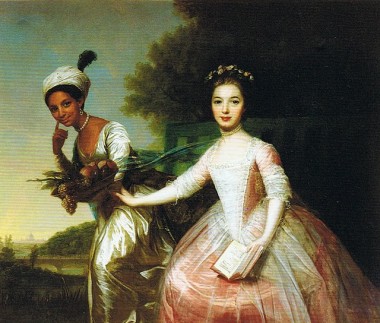
(Portrait of Dido and Elizabeth)
In spite of its lack of grittiness, Belle was a good, enjoyable movie, overall, and far better than some of the recent substitute-action-for-plot-and-character-development movies that have been coming out of late.
(Personally, I think Garrow’s Law, a sadly shortlived BBC TV show, was way grittier than Belle!)
Here’s the trailer to the movie – enjoy!
I read your piece because I was intrigued by your tweet.
Why was Andrew Buchan featuring, I wondered?
Historical film/tv? hair? tears? were all possibilities.
Also …. Andrew Buchan’s first acting job after leaving RADA was on stage in Manchester as Mercutio to Gugu Mbatha-Raw’s Juliet
– I love coincidences…. 🙂
That is indeed an amazing coincidence! I didn’t know they’d acted together before – and both of them have been in a story about the terrible happenings on the Zong, which is also a coincidence. : D
Both of them are very good at what they do.
Her first mistake was trying to brush it. That only makes things worse and I’m speaking from experience. 🙂
And you think she’d know better by her age! The whole scene dragged me right out of that era!